
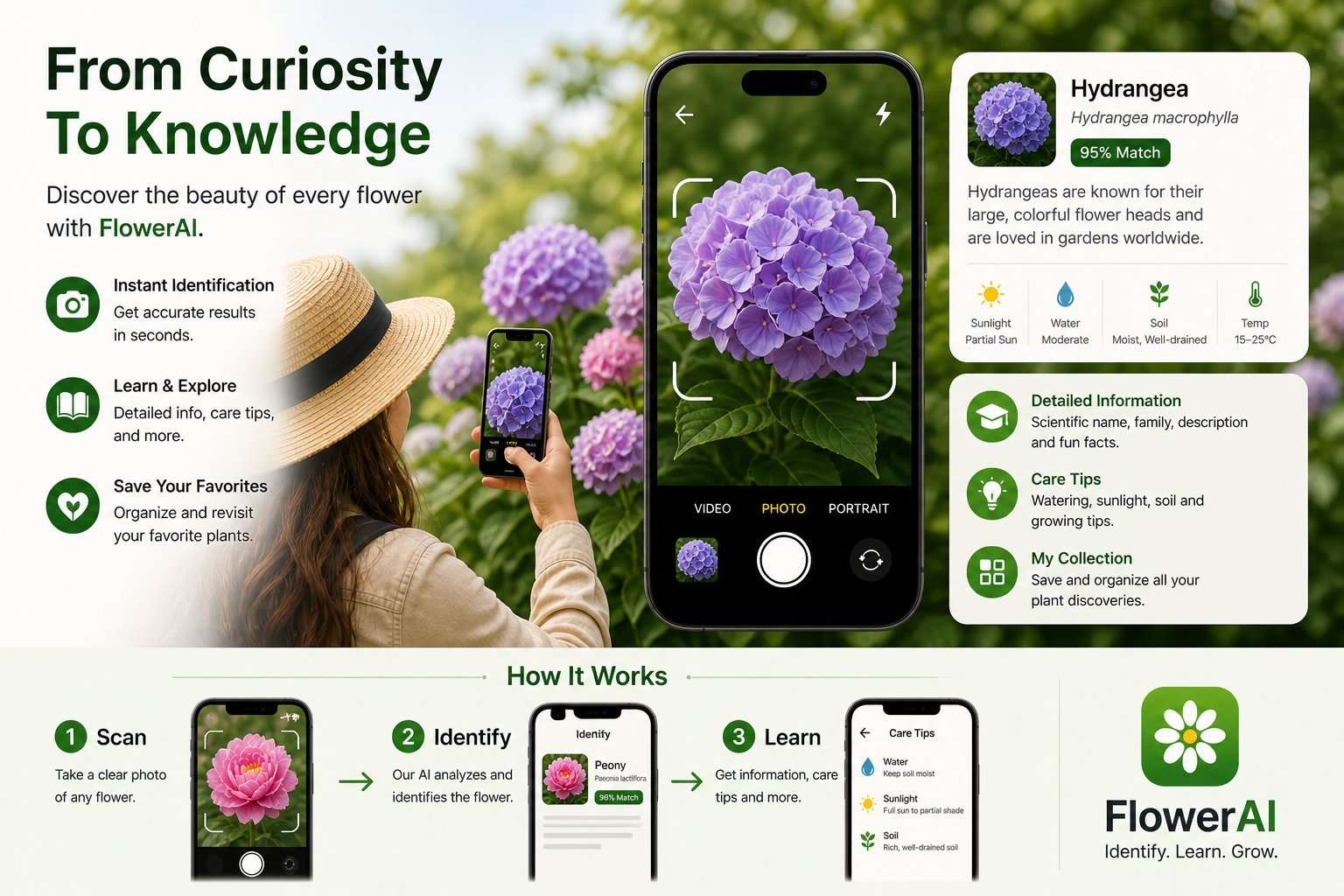
Kids notice flowers. They notice color, smell, the way a bee dives into a foxglove, the way a dandelion turns into a wishing puff overnight. What they often don't have is a way to put names to what they see — and a flower identifier app, used the right way, can turn an ordinary walk into something they remember for years.
This is a guide for parents, grandparents, and teachers who want to use a simple app to spark real curiosity. None of it requires expertise. The goal isn't to make your kid a botanist. It's to give them a tool that turns "look at this!" into "look at this columbine!"
Start with what they already love
Kids respond to color long before they care about taxonomy. The easiest entry point is to follow their lead: if they keep picking up the yellow ones, focus on yellow flowers for a week. Dandelions, buttercups, daffodils, black-eyed Susans — there's a surprising amount of variety once you start looking.
Once they have a few they recognize on sight, the app becomes a way to confirm and expand: "You think it's a buttercup? Let's check." The app's answer becomes the small reward, and being right starts to feel good.
Make the photo the kid's job
This is the part that turns identification from passive (parent points, kid looks) into active (kid hunts, kid documents). Hand them the phone — supervised — and let them frame the shot.
Three rules, simple enough for a five-year-old:
- Get close: the flower should be bigger than your face on the screen.
- Hold still: count to three before tapping the button.
- Tap to focus: tap the flower on the screen so it's not blurry.
That's it. Their photos won't be magazine quality, but the AI handles imperfect images gracefully, and the act of taking the picture is what makes them remember the flower.
Build a flower journal
This is the trick that keeps the activity going for months instead of an afternoon.
Get a small notebook, ideally one the kid picks out themselves. After each walk, print or draw the flowers they identified that day. Have them write the name underneath — even if it's wobbly, even if it's just the first letter for younger kids. Add the date and the place.
Within a few weeks they'll have their own field guide, with their own evidence, in their own handwriting. The pride this produces is hard to overstate.
Some variations:
- Pressed flower journal: press a sample of each flower (only common, non-protected species) between book pages or in a flower press. After a week, glue the pressed bloom into the notebook beside the name.
- Color-coded pages: dedicate one page to each color. New yellow flowers go on the yellow page.
- Map journal: sketch the route of your walk and dot where each flower was found.
Games that actually work
A few activities we've seen succeed with kids ages 4-10:
Flower bingo. Print or draw a 3x3 grid of common local flowers (the app's "by state" pages or a regional field guide help here). On a walk, the kid marks each one they spot and identifies. First to bingo wins.
The naming game. Before checking the app, the kid invents their own name for a new flower based on what it looks like. "Star with hairy legs." "Purple bell." Then they look up the real name and compare. The app's answer becomes a punchline; the invented names go in the journal too.
Photo scavenger hunt. You give a list — find one yellow flower, one with five petals, one growing near water, one taller than your knee. Kid hunts, photographs, identifies.
Twin hunt. Some flowers have look-alikes. Find the twins and figure out the difference. Wild carrot vs. poison hemlock (advanced and supervised), buttercup vs. yellow rose-of-Sharon, daisy vs. fleabane.
What to teach about touching
This is where flower identification turns into a small but important lesson about respecting nature.
A few simple rules for younger kids:
- Look first, touch second, pick rarely. Most identification can happen without picking the flower at all.
- Never pick on protected land. National parks, state parks, nature preserves: photos only.
- If you do pick, pick from a patch of many. Never the only one of something.
- Some flowers are not for touching. Stinging nettles, poison ivy lookalikes. Teach what they look like before the kid encounters them by surprise.
The app is a good tool for the last one — when you spot a plant you suspect is harmful, identify it together and make a clear teaching moment of "this one we look at, we don't touch."
Build seasonal awareness
One of the deepest lessons flower identification teaches kids is that the world changes on a schedule. The same path looks completely different in April and August.
Some prompts that get this across:
- Visit the same patch of ground monthly. What's blooming this time that wasn't last time?
- Make a "first bloom of spring" tradition each year. The first crocus, the first daffodil, the first dandelion — track the date.
- Notice when something disappears. Where did all the snowdrops go?
Kids who grow up paying attention to seasonal flowers grow up paying attention to the natural calendar in general — when the geese come back, when the trees turn, when the bees show up.
For older kids: teaching real botany
By 9 or 10, many kids are ready for the next layer. The app gives them the species name; you can give them the structure underneath.
A gentle progression:
- Petal counting and symmetry. Most flowers have a "magic number" — 3, 4, 5, or 6 petals. Why?
- Flower families. Once they spot that daisies, sunflowers, and dandelions all have the same "ray and disk" structure, they've learned a real botanical concept (the Asteraceae family).
- Pollination. Show them the stamens and pistil. Talk about why bees come, why some flowers smell at night, why some are red and some are white.
- Native vs. introduced. Many of the most common flowers in North America came from somewhere else. Which ones belong here? This opens up bigger questions about ecology.
Keep it light
The fastest way to kill flower identification as a hobby is to turn it into a quiz. The app should feel like a friend on the walk, not a teacher with a clipboard. If the kid wants to skip the app one day and just smell things, that's fine — that's also flower identification, in a sense.
The point is the noticing. Everything else builds on that.
Try Flower Identifier — free on iPhone
AI-powered flower ID from a single photo. Bloom, leaf, or whole plant. No account required.
Download on the App Store