
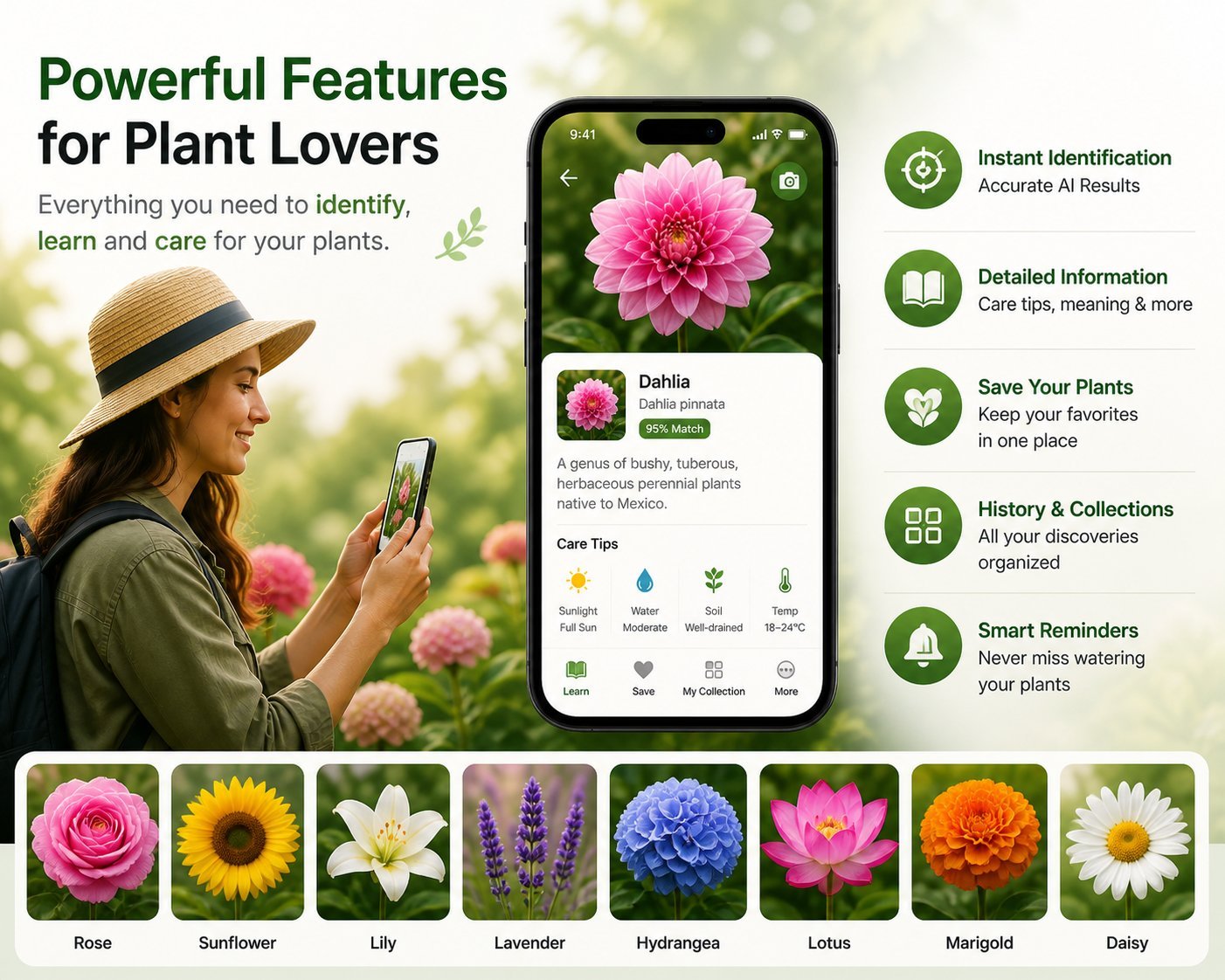
If you walk through 100 American backyards, you'll see roughly the same 25-30 flowering plants over and over. They're popular for good reasons — easy to grow, deer-resistant, attractive to pollinators, and either native or naturalized to the climate. Knowing them on sight saves you from scanning the same flower 50 times across a season.
This is a quick reference for the 10 most common backyard flowers across the US, with the visual features that distinguish each one and what they tell you about a yard. Whether you have a flower identifier app or just want to learn the basics, start here.
1. Black-Eyed Susan (Rudbeckia hirta)
Bright yellow ray petals around a dark brown to black central cone. Native to North America, blooms mid-summer through fall. Often confused with sunflowers (much smaller, smaller plant) and daisies (yellow not white, dark center not yellow). The leaves are coarse and hairy. Found in yards from Texas to Maine, especially in the Midwest where it's the state flower of Maryland.
Quick ID: yellow ray + dark dome center + coarse hairy leaves = Black-Eyed Susan.
2. Hosta (Hosta spp.)
Famous for its leaves more than its flowers, but the flowers do appear — pale lavender or white tube-shaped blooms on a tall stalk above broad ribbed leaves. Hostas dominate shade gardens across the country and are the single most planted shade perennial in the US. The leaves come in green, blue-green, variegated, and yellow forms.
Quick ID: broad ribbed shade-loving leaves + tall flower spike with bell-shaped blooms = Hosta.
3. Daylily (Hemerocallis spp.)
Trumpet-shaped flowers in yellow, orange, red, pink, or bicolor, atop tall scapes above strappy grass-like foliage. Each bloom lasts a single day (hence the name) but plants produce blooms continuously for weeks. The orange daylily (Hemerocallis fulva) is naturalized along roadsides across the country and frequently called "ditch lily."
Quick ID: trumpet flower + strappy leaves at the base + multiple buds per scape = Daylily.
4. Hydrangea (Hydrangea macrophylla)
Large pom-pom or lacecap flower clusters on a woody shrub, with broad serrated leaves. Color depends on soil — acidic soil gives blue, alkaline gives pink, neutral gives purple. The bigleaf hydrangea is the most common in foundation plantings, but smooth (H. arborescens) and panicle (H. paniculata) hydrangeas are also widespread.
Quick ID: woody shrub + huge clustered flower head + broad serrated leaves = Hydrangea.
5. Coneflower (Echinacea purpurea)
Drooping pink or purple ray petals around a spiny orange-brown central cone. A US native prairie wildflower that has become a backyard staple thanks to its drought tolerance and pollinator value. Blooms from early summer to first frost and often persists through winter as a seed head for birds.
Quick ID: droopy pink/purple petals + spiky orange dome center = Coneflower.
6. Daffodil (Narcissus spp.)
Yellow or white six-petaled flowers with a central trumpet (corona), on bare stems in early spring. Among the earliest spring flowers, often appearing through snow. Naturalized in old yards across the country — clumps that have been multiplying for 50+ years are common in older neighborhoods.
Quick ID: early spring + six tepals + central trumpet = Daffodil.
7. Tulip (Tulipa spp.)
Six-tepaled cup-shaped flowers on a single stalk above a few broad strap-like leaves, in nearly every color except true blue. Spring blooming, originally from Central Asia, and short-lived in most US climates (often replanted as annuals). The Netherlands ships millions of bulbs to American gardeners each fall.
Quick ID: single cup-shaped flower + 2-4 broad leaves at base + spring bloom = Tulip.
8. Iris (Iris spp.)
Three upright "standards" and three drooping "falls" make up the distinctive iris flower shape. Comes in purple, blue, yellow, white, and bicolor. The bearded iris is the most common in yards, with a fuzzy "beard" along each fall petal. Tall sword-like leaves grow from rhizomes at the base.
Quick ID: three up + three down petals + sword-like leaves = Iris.
9. Rose (Rosa spp.)
Many-petaled flowers in essentially every color except blue, on thorny woody stems with compound leaves. Hybrid teas, floribundas, climbers, and shrub roses are all common. The Knock Out rose (a disease-resistant shrub rose introduced in 2000) has become the most-planted rose in America thanks to its bulletproof reputation.
Quick ID: thorns + many petals + compound leaves with serrated edges = Rose.
10. Peony (Paeonia spp.)
Large, lush, multi-petaled flowers in pink, white, red, or coral, on a 2-3 foot perennial that returns reliably for decades. Spring to early summer blooming. The leaves are dark green and divided. Peonies are often planted as memorial flowers and many backyards have peonies older than the homeowners.
Quick ID: huge ruffled flower + dark divided leaves + 2-3 foot bushy perennial = Peony.
Honorable mentions
Beyond the top 10, you'll also frequently see:
- Marigold — annual, orange or yellow, garden borders
- Petunia — annual, trumpet-shaped, hanging baskets
- Geranium — annual or houseplant, clusters of red/pink flowers
- Pansy — cool-season annual with face-like markings
- Zinnia — annual, daisy-like, many colors
- Salvia — perennial spike, often blue or red
- Lavender — fragrant purple spikes, woody base
- Sedum — succulent leaves, late-summer flat-topped flowers
- Lily — trumpet flowers, tall stems
- Lily of the Valley — small white bells, shade ground cover
How to use this list with a flower identifier app
The 10 species above account for maybe 60% of what you'll see in any given American backyard. If your flower identifier app returns a result that doesn't match one of these, it's worth double-checking — common things are common. If the app says you've found a rare orchid in your front yard, the much more likely answer is a daylily or a hosta in bloom.
Once you can recognize the top 10 on sight, you can save app scans for the genuinely interesting flowers — wildflowers, weeds, neighbor's exotics, and anything you've never seen before.
What this list tells you about American gardening
The 10 most common backyard flowers in the US are dominated by drought-tolerant, low-maintenance, deer-resistant, multi-decade perennials. American homeowners increasingly favor "set it and forget it" plants over fussy annual beds. Native plants like coneflower and Black-Eyed Susan are gaining ground over imported ornamentals, partly because of pollinator awareness and partly because they truly do thrive in local climates without much input.
Knowing what's most common is itself a kind of identification — recognizing a yard's "vocabulary" of plants tells you who's gardening and how. From there, anything unusual becomes interesting and worth scanning.
Final thought
Memorizing the 10 most common backyard flowers in the US gives you a baseline. After that, every walk past a neighbor's yard becomes a kind of casual botany — most of what you see is already known to you, and the unfamiliar things stand out. That's when an app like Flower Identifier earns its place: not for the daylilies, but for the species you've never encountered before.
Try Flower Identifier — free on iPhone
AI-powered flower ID from a single photo. Bloom, leaf, or whole plant. No account required.
Download on the App Store