
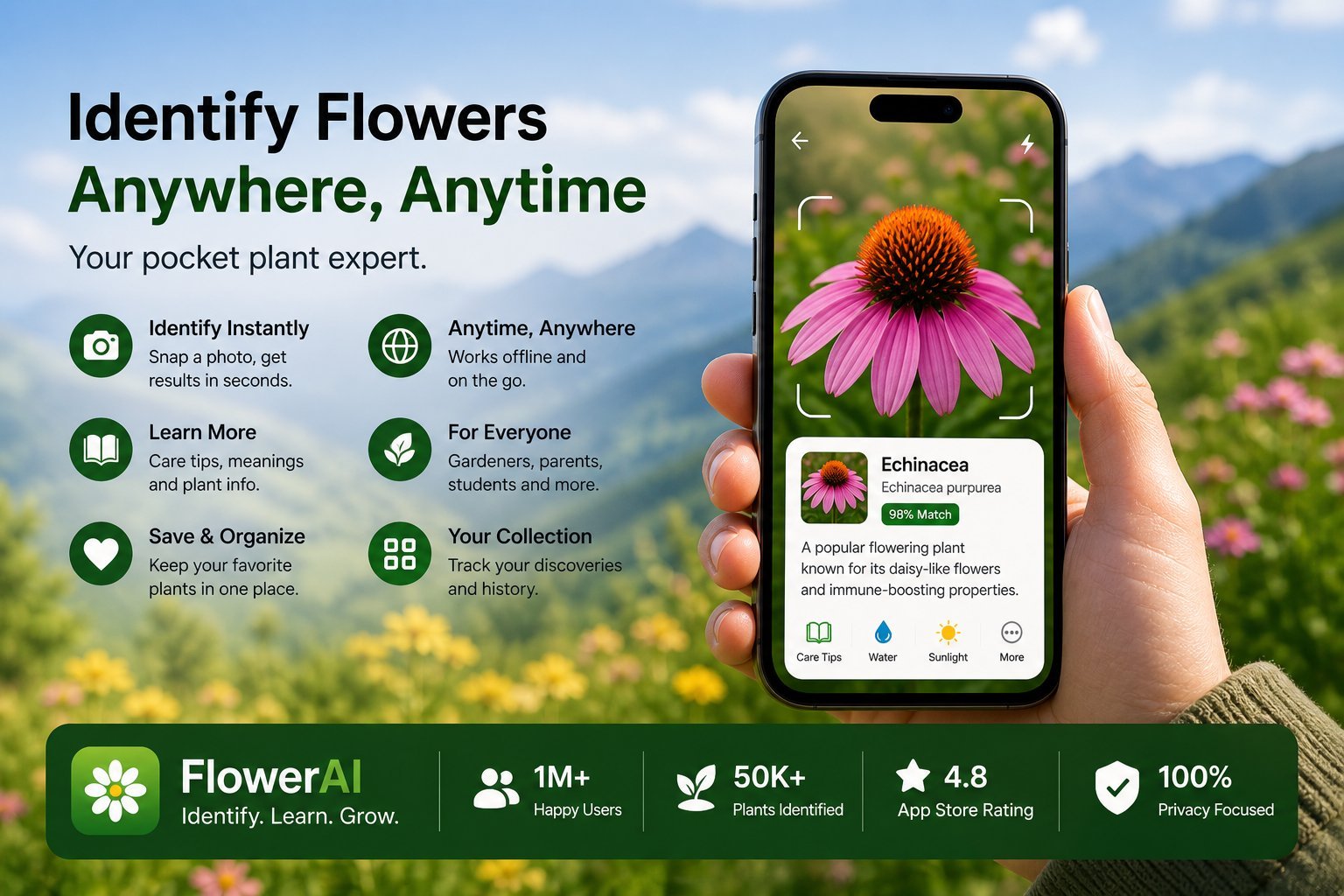
Wildflower identification used to mean carrying a 600-page Peterson field guide and a hand lens, then flipping pages until you found something that matched. It worked, but it was slow, regional, and frustrating for anyone who wasn't already a competent botanist. Today, a phone camera and a flower identifier app can do the same job in 10 seconds — if you know what to photograph.
This guide is for hikers, campers, gardeners, and casual nature enthusiasts who want to identify wildflowers from their phone. We'll cover what makes wildflowers different from cultivated flowers, how to photograph them well, and the species you're most likely to encounter on North American trails.
Why wildflowers are harder to ID than garden flowers
Garden flowers are bred for showy, distinctive looks — a tulip is a tulip whether it's in Amsterdam or Albuquerque. Wildflowers are different. They're often:
- Smaller and less colorful than their cultivated cousins
- More variable — the same species can look different in different soils, climates, or seasons
- Surrounded by similar-looking species that diverged a few thousand years ago
- Less photographed, so AI training data is thinner for rare species
The result: a flower identifier app that nails 95% of garden flowers might land at 75-85% on wildflowers. That's still good — but it means you should treat the app's first answer as a candidate, not a verdict.
How to photograph a wildflower for accurate ID
The same rules that apply to garden flower photography apply double in the wild:
1. Get low
Most wildflowers are short. The natural instinct is to bend at the waist and shoot from above, but you'll get a better photo if you crouch or kneel and shoot at flower height. The camera should be roughly level with the bloom.
2. Capture three views
For wildflower ID, three photos are much better than one:
- The bloom from straight on — for petal count, color, and shape
- The leaves and stem — leaf arrangement is one of the most species-specific clues
- The whole plant in context — habitat tells the AI a lot about which species to consider
3. Note the location
Geographic context is huge for wildflower ID. A pink lily-like flower in a Pacific Northwest bog is a different species than the same shape on a Rocky Mountain alpine meadow. Most apps will pull GPS from the photo's metadata if you allow it.
4. Don't pick the flower to photograph it
Many wildflowers are protected, and even unprotected ones lose key identifying features (like leaf arrangement) when picked. Photograph in place. Bonus: a freshly picked flower starts looking wilted within minutes, which makes the photo less useful anyway.
The wildflower features that matter most for identification
If your app gives you a few candidate species and you need to break the tie, look at:
Petal count and arrangement
Many wildflower families have a consistent petal count. Mustards have 4 petals in a cross, mint family has petals fused into a tube. Counting petals narrows the candidates fast.
Leaf shape and arrangement
Are the leaves opposite (in pairs across from each other), alternate (one at a time, alternating sides), or whorled (three or more from a single point)? This is one of the most reliable family-level clues.
Stem characteristics
Is the stem round or square? Square stems are characteristic of the mint family. Hairy or smooth? Hollow or solid? These small details often pin down the genus.
Habitat
Wet meadow, dry hillside, forest understory, alpine scree? Each habitat has a characteristic flora. A wildflower app that uses location automatically applies this filter; if yours doesn't, do it yourself by mentally narrowing to species that grow where you found the flower.
The 10 most-photographed wildflowers in North America
These show up everywhere and are worth learning to recognize:
- Black-Eyed Susan (Rudbeckia hirta) — yellow ray petals, dark center, mid-summer to fall, prairies and roadsides east of the Rockies.
- Indian Paintbrush (Castilleja spp.) — orange-red bracts that look like petals, late spring to summer, western mountain meadows.
- Wild Lupine (Lupinus perennis) — purple-blue spikes, palmate leaves, late spring to early summer, sandy soils east of the Mississippi.
- Goldenrod (Solidago spp.) — tall yellow plumes, late summer to fall, almost everywhere in eastern North America.
- Wild Bergamot (Monarda fistulosa) — pinkish-purple raggedy heads, square stems (mint family), summer, prairies and meadows.
- California Poppy (Eschscholzia californica) — bright orange cup-shaped flowers, spring, California and the Southwest.
- Trillium (Trillium spp.) — three petals, three sepals, three leaves, spring, eastern hardwood forests.
- Bluebonnet (Lupinus texensis) — blue spikes with white tips, spring, Texas Hill Country.
- Fireweed (Chamaenerion angustifolium) — tall pink spikes, summer, recently burned or disturbed ground in the north.
- Common Yarrow (Achillea millefolium) — flat-topped white clusters, feathery leaves, summer, fields and roadsides everywhere.
When a flower identifier app is wrong on a wildflower
It happens. The app confidently tells you something is Aster novae-angliae when it's actually a closely related species. A few sanity checks:
- Does the species exist where you are? Check the species range on iNaturalist. If your location isn't in the range, the app is wrong.
- Does the bloom time match? If the app says it's a spring ephemeral and you photographed it in October, the app is wrong.
- Do the leaves match? If the petal photo gave the right family but the leaves don't match the species in field guide images, the species is wrong even though the family is right.
Going further: from app to expert
If you become a regular wildflower photographer, you'll outgrow any app. The next step is joining a regional botanical society, downloading state-specific field guides, and uploading observations to iNaturalist where expert botanists confirm IDs and contribute to conservation data. Your photos help science. The app is the entry drug; the rest is the hobby.
Final thought
Wildflower identification is a skill worth building. Once you can name the plants growing along a trail, hikes feel different — you stop seeing "trees and bushes" and start seeing a community of species, each with a story. The flower identifier app on your phone is the fastest way to start that journey. Take the photos, save the IDs, and within a season you'll start recognizing wildflowers without needing to scan them at all.
Try Flower Identifier — free on iPhone
AI-powered flower ID from a single photo. Bloom, leaf, or whole plant. No account required.
Download on the App Store